

Within the citric acid cycle, isocitrate dehydrogenase (IDH) catalyzes the essential conversion of isocitrate into α-ketoglutarate. This enzyme meditates a simple oxidation of an alcohol to an α-ketoacid, followed by a spontaneous decarboxylation. Three mammalian isoforms of IDH exist (IDH1, IDH2, IDH3) catalyzing this reaction using NAD+ or NADP+.1 As we learned in lecture, IDH1 is the cytoplasmic isoform and IDH2 is the mitochondrial isoform that are typically mutated in cancer. These mutated forms use the α-ketoglutarate product to form the oncometabolite 2-hydroxyglutarate. Although mutated isoforms of IDH can have harmful effects, functional IDH isoforms can have protective properties. Lee et. al. demonstrated a protective characteristic of IDH2 in preventing metabolic stress from a high-fat diet by decreasing oxidative damage to brown adipose tissue mitochondria. The authors of this paper showed that mice with a knocked out IDH2 (IDH2KO) enzyme went through an accelerated weight gain when fed a high-fat diet.2 Furthermore, in knocking out the enzyme, the authors recognized a crucial role for IDH2 in limiting ROS-dependent mitochondrial damage.
Lee, J.-H.; Go, Y.; Kim, D.-Y.; Lee, S. H.; Kim, O.-H.; Jeon, Y. H.; Kwon, T. K.; Bae, J.-H.; Song, D.-K.; Rhyu, I. J.; et al. Isocitrate Dehydrogenase 2 Protects Mice from High-Fat Diet-Induced Metabolic Stress by Limiting Oxidative Damage to the Mitochondria from Brown Adipose Tissue. Experimental & Molecular Medicine 2020.
Initially, the authors fed IDH2KO and WT mice a high-fat diet (HFD) and low-fat diet (LFD), resulting in four groups of mice: HFD IDH2KO, LFD IDH2KO, HFD WT, and LFD WT. The authors isolated primary brown adipocytes from the BAT by collagenase digestion, and a mitochondrial ROS production assay was performed in order to verify how ROS are normally controlled in BAT. Brown adipose tissue (BAT) plays a key role in regulating body thermogenesis, energy expenditure, and glucose metabolism.3 Since BAT plays such an important role, the authors compared the weight gain in the WT mice versus the IDH2KO mice for both HFD and LFD.
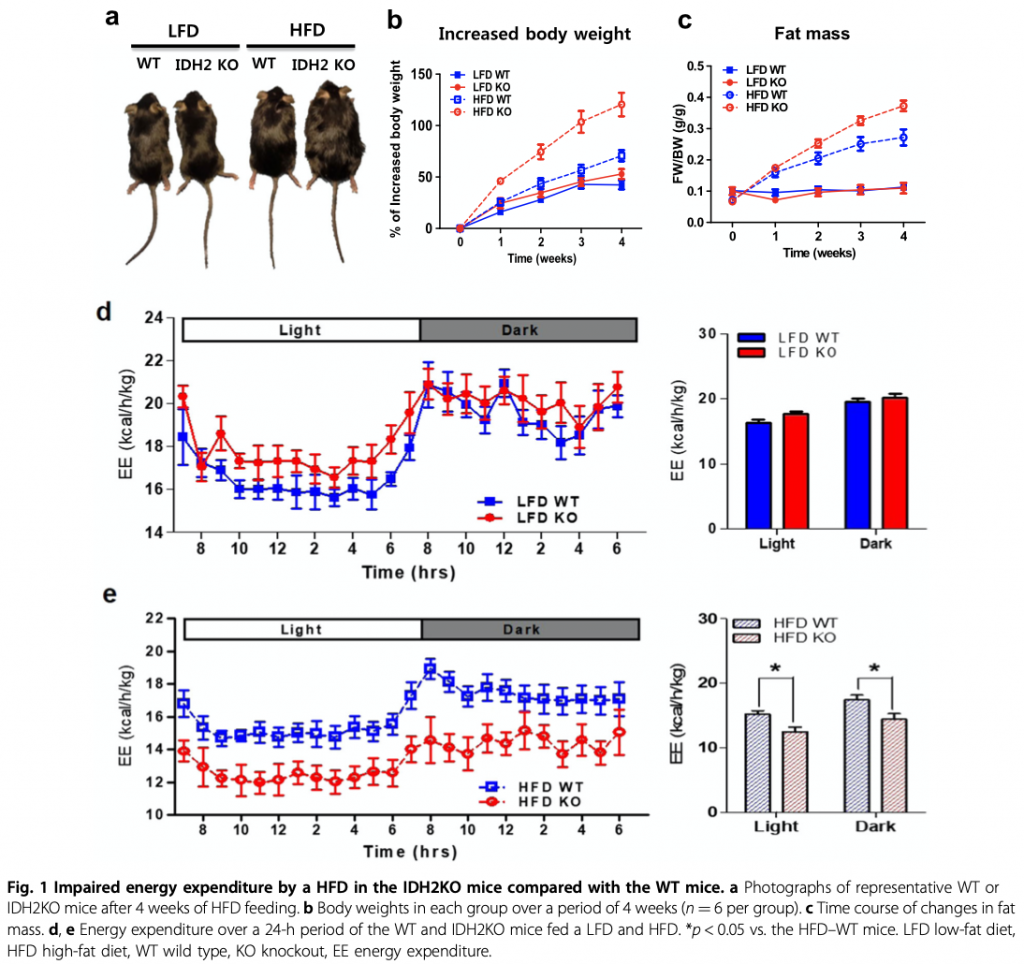
As seen in the figure above, the authors observed that the HFD IDH2KO mice gained double the body weight compared to LFD WT and LFD IDH2KO (part a). However, HFD WT mice gained less weight compared to HFD IDH2KO (part b). The authors noticed that the body weight gain and increased body fat composition in the HFD IDH2KO mice had significantly impaired whole-body energy expenditure compared to LFD IDH2KO (seen in parts d and e). These differences were present even though the mice performed the same physical activity and had identical food and water intake. The authors claim that this discrepancy suggests that without a functioning IDH2, drastically accelerated fat accumulation from a HFD will be seen.
After this observation, the authors hypothesized that the excess weight gain in the HFD IDH2KO mice may be a result of mitochondrial disfunction in the BAT. The authors performed an RNA-seq comparison of the gene expression of the BATs in WT and IDH2KO for both LFD and HFD and confirmed that mitochondrial function associated genes were expressed at reduced levels. Further analysis showed that citric acid intermediates following IDH and NAD+, NADH, NADP+, and NADPH were also significantly decreased. The reduced presence of the compounds was consistent with a decrease in cellular redox control due to decreased IDH activity.
Since these observations verified that energy expenditure was being impacted negatively, the authors evaluated the way ROS levels were affected. The treatment showed that mRNA and protein levels of three important regulators of cellular ROS were reduced in BAT tissue of WT IDH2KO and HFD IDH2KO. From this information, the authors concluded that the loss of IDH2 in BAT results in defective ROS regulation. Since the mice are under metabolic stress from a HFD, they cannot control excess ROS accumulation, which leads to oxidative damage to the mitochondria. With this discovery, the authors hypothesized that inhibiting the ROS accumulation should reverse the mitochondrial disfunction and lead to a decrease in the weight gain of HFD IDH2KO.
The authors added a potent antioxidant BHA into the HFD WT and HFD IDH2KO mice in order to test the hypothesis. The BHA resulted in a significant decrease in weight gain in both sets of mice. In order to identify genes working to cause this phenomenon, the authors performed RNA-seq of the BAT from the HFD WT and HFD IDH2KO. They found that genes associated with mitochondrial function, energy expenditure, NAD regulation, and ROS resolution were significantly downregulated in the HFD IDH2KO compared to the HFD WT. Additionally, mitochondrial issues were partially reversed by the BHA treatment. From these observations, the authors concluded that weight gain and mitochondrial dysfunction occurred since the loss of IDH2 results in elevated ROS levels.
Mitochondrial homeostasis is maintained through limitations in ROS production. The authors discovered that this response is disrupted in IDH2KO mice. The mitochondria were unable to perform its normal functions and resulted in severe oxidative damage to the mitochondrial enzyme system involved in energy expenditure. The oxidative damage caused the development of an accelerated obesity rate. Mitochondrial enzymes also produce NADPH to modulate redox balance. Mitochondrial NADPH is a critical cofactor in limiting mitochondrial ROS accumulation. Overall, this study demonstrated that the loss of IDH2 causes a major disruption of the mitochondrial function to metabolic stress of HFD in BAT.
Future work can consist of identifying a mechanism for how mitochondrial NADPH is balanced by IDH2. Since NADPH plays a role in maintaining redox balance in ROS accumulation, NADPH could be used to combat any ROS accumulation if IDH2 is mutated or nonfunctional. Since IDH2KO results in ROS accumulation, a functional IDH should result in limiting mitochondrial ROS accumulation, but the mechanism behind how this is accomplished is unknown. Additionally, since IDH2KO resulted in a decrease in succinate and fumarate, effects on gene expression are mediated through altered methylation of DNA or histones as a consequence. The mechanistic characteristics of the citric acid cycle products can be observed to discover the extent to which the rest of metabolism is negatively impacted.
1 Smolková, K.; Ježek, P. The Role of Mitochondrial NADPH-Dependent Isocitrate Dehydrogenase in Cancer Cells. International Journal of Cell Biology 2012, 2012, 273947.
2 Lee, J.-H.; Go, Y.; Kim, D.-Y.; Lee, S. H.; Kim, O.-H.; Jeon, Y. H.; Kwon, T. K.; Bae, J.-H.; Song, D.-K.; Rhyu, I. J.; et al. Isocitrate Dehydrogenase 2 Protects Mice from High-Fat Diet-Induced Metabolic Stress by Limiting Oxidative Damage to the Mitochondria from Brown Adipose Tissue. Experimental & Molecular Medicine 2020.
3 Villarroya, F.; Cereijo, R.; Villarroya, J.; Giralt, M. Brown Adipose Tissue as a Secretory Organ. Nat Rev Endocrinol 2017, 13 (1), 26–35.

13 Responses
This was a very interesting paper that brings together things that are generally known about the relationship between oxidative stress, inflammation, and obesity (it would not be surprising to me if an IDH2 knockout had oncogenic implications as well for these very reasons). The biggest question ruminating in my mind while reading this was why exactly it is the case that a dietary disparity makes ANY DIFFERENCE AT ALL (in the context of an IDH2 knockout) on the weight gain of the mice, since that step of TCA is fundamentally blocked irrespective of whether they consume a LFD or HFD. Even contemplating the relationship of ROS production, it is initially unclear to me how blockage of this step generates significantly greater oxidative stress in the context of a HFD. The way I reconciled this was under the presumption that a LFD is synonymous (most likely) with a higher carbohydrate diet since they maintain the mice on a constant caloric intake between the two diet groups. A higher carb diet would favor glycolysis, which ultimately facilitates production of acetyl-CoA. It is clear that a HFD would favor enhanced FAO (and perhaps even ketosis depending on the relative component of CHO remaining in the diet); such a diet would ALSO result in production of acetyl-CoA, which as we discussed in class, is dramatically more efficiently produced via FAO than it is from oxidation of glucose. Therefore, it seems to me that from a gross metabolic standpoint, a HFD forces more acetyl-CoA through TCA on a per calorie basis, thus contributing more dramatically to ROS production in the context of the K/O that is ill-equipped to manage it. The authors call attention to the importance of the ROS phenomenon, which contrary to what I initially believed, seems to be the primary factor modulating this gain of body weight in the knockout mice, rather than the actual metabolic block itself. You also note the authors’ mention of the importance of NADPH in mitigating ROS accumulation in the mitochondria. As a LFD (as I previously interpreted it) would promote greater glycolytic flux, this may correspond to a better ability of these adipocytes to shunt glycolytic intermediates into the Pentose Phosphate pathway, and therefore generate more NADPH; this is considered relative to a HFD in which glycolysis could be more or less circumvented by FAO. Do you agree with this interpretation, or am I missing a bigger picture that the authors are trying to address here?
I think this research is really interesting, especially how the LFD and HFD IDH2KO affected gene expression and function. This could be important research in understanding weight gain since someone might have a mutation which results in a similar response and perhaps explain why they gain weight easily and might make them more aware of what diet they should consider to remain healthy. The idea that this is also damaging the mitochondria is interesting because they are so crucial, and mitochondria which function below optimal levels would likely be very harmful as well. In terms of the ROS, do you know how specifically they damaged the mitochondria and what they might have reacted to to cause oxidative damage? Also I’m not sure if you were able to find anything about this, but do these knockdowns also make it harder for the animal to lose weight so that not only does a mutation cause weight gain but losing weight is harder and therefore a low fat diet would be crucial to stay healthy
A quick question about what you wrote and I’m probably misunderstanding this so just a simple clarification would be nice, but you said the HFD and LFD IDH2KO were given the exact same food and water. Reading the methods was a bit confusing, but did they make a high fat mixture which they then added to the food and that was how they prepared the HFD?
Hey Iffat! Missing you already (gotta love social distancing) but thanks for powering through and giving us such an interesting take on the power of IDH2. I’m especially intrigued by the way through which the authors were able to disturb ROS regulation, and then treat it– first by creating IDH2 knockouts, then restoring homeostasis by adding the antioxidant– effectively reversing the issue and confirming their suspicions to be true. We’ve been talking in class bout the ways in which these experimental designs make high-impact papers, so it definitely caught my attention! I agree with you on your ideas for future work; illuminating the mechanism for exactly how NADPH and IDH could open several doors for clinical applications of this knowledge. Like Eli, I’ve taken some pause with the cancerous potential of an IDH2 knockout , especially in light of our course lectures. It seems to me that the positive promise of IDH2 and the oncogenic possibilities wouldn’t be occurring independent of each other, such that the tissue of study might be subjected to more than just oxidative stress. Do you think that it might be possible that the modulations in redox balance could have also been impacted by oncogenic tissues’ disrupted metabolisms (my mind goes to the Warburg effect, just because of our coursework, but any kind of altered growth/proliferation scheme makes me wonder)? It’s definitely possible that I’m making connections where they don’t or can’t occur, so I’d love your input if you have any thoughts or knowledge I missed! Thanks!
Hi Em!! I was actually initially surprised that the authors were able to restore normal metabolic ROS regulation by adding the antioxidant. I thought that the IDH2 KO may have caused the ROS regulation to be affected in a manner that would cause it to be nonfunctional , but as seen, the authors demonstrated otherwise.
The question you pose is very interesting! I did not think of the oncogenic implications, probably because that was not the focus of the paper, but of course, that would be of concern. Realistically, since everything is negatively impacted by the proliferative growth of cancer cells, redox balance is most likely affected as well. As we learned in class, the proliferative nature of the cancer cells causes them to use glucose to form lactate, instead of undergoing OXPHOS and other pathways that lead to the formation of NADPH. Perhaps the possible effect of decreased NADPH production can cause ROS regulation to be decreased, forming more ROS, since NADPH is a major player in ROS regulation.
This really is a very interesting article that you chose to cover and you did an excellent job breaking down the relevant background and findings of the paper. Believe it! (I realize that would only really make sense if you watched the dub). Anyway, I’m still trying to wrap my head around the idea of shutting down IDH2 causing only relatively minor effects, probably mostly because I’ve learned biochemistry in such a Citric Acid Cycle-centric way so I’ve been trying to tackle this from a different perspective. (thinking out loud) If we sort-of assume the main source of energy generation in aerobic systems is to generate more reduced species so it can be put through OXPHOS then I guess if makes more sense as to why shutting down a step in all mitochondrial TCA cycle still produces viable organisms. My next question then is why the authors chose IDH as the dehydrogenase they wanted to test when there were many other enzymes that catalyze reactions that, at least on a base level, are just as effective at generating reduced species?
Hi Ethan! I really appreciated the Naruto reference, very fitting for this paper. I was shocked to see that the IDH2 KO did not drastically impact the citric acid cycle in a negative way. After continuing reading the paper I realized and as Alex mentioned, there are three isoforms of IDH that have slightly different roles in metabolism, but ultimately, each still catalyzes the reaction of isocitrate into α-ketoglutarate. The presence of the other isoforms is most likely the reason for the citric acid cycle being able to function properly without too much damage with an IDH2 KO.
Your question is very interesting, as that is something so simple yet very important. I think the authors focus on IDH may have due to the large role that IDH plays in cancer. Since mutated IDHs are seen in cancer cells, perhaps learning the ins and outs of how IDH works can be helpful towards learning how cancer cells work and how the spread of the growth can be prevented. Although the focus of this paper was not cancer, I think a lot of the implications can be used towards cancer cell research.
This was a great article to provide further insight into the research surrounding an enzyme which we focused on in class! I am curious if this research will be applicable in humans as a potential focus for reducing obesity. This could definitely account for some of the metabolic differences between individuals who struggle to lose/maintain weight and those who have no issue weight gain. However, I know there are sometimes issues when translating studies regarding obesity from mice to humans. I am particularly interested in the mitochondrial damage that occurs from the oxidative stress. The authors demonstrated that these effects could be partially reversed with BHA treatment; however, is there still some permanent damage that remains? I’m just thinking that if this is applicable in humans, is it something that needs to be treated early to prevent permanent damage or could more time and the creation of a specific drug allow for normal mitochondrial function?
Hi Delsin! I like your thought process behind this topic, definitely something interesting! As you stated, the translation from mice to humans is always difficult because of the unknown effects that the experiments can cause in humans. However, I do think a study of this type can be accomplished in different human cell types to observe the localized effects, without the possibility of directly having a harmful effect on humans.
I think your question is interesting because I do not think there is permanent damage that remains, since the authors were able to show full functionality after the treatment. However, other effects may possibly be seen in the way the cells function. I think your second question is something that could be focused on for future work from this paper. After learning more effects of IDH on mitochondrial functions, conclusions of those effects can be drawn.
Wow, great find, Iffat! I think it’s incredible that oxidative stress can somehow lead to obesity, at least in mice, and that a citric acid cycle enzyme can play such a defining role. Studies like this go to show that obesity isn’t simply a lifestyle choice like many people still think. I’d like to know your thoughts on a couple things I think the study left unsolved.
First, the IDH2KO mice obviously had no IDH2 to use in the mitochondria for the citric acid cycle. I initially thought this would be detrimental for metabolism and would cause more damage than just obesity. But since LFD IDH2KO mice barely gained more weight than LFD WT mice, there must be something else going on. Could the cell be repurposing IDH1 to the mitochondria because something’s better than nothing?
Also, it seemed like BHA treatment didn’t completely solve the issues brought about by loss of IDH2. You said it significantly decreased weight gain in both HFD groups, meaning antioxidants assist with weight loss regardless of IDH2. You also said mitochondrial issues were partially reversed, so there has to be another big piece of the story besides the ROS/metabolic stress narrative. I’d be interested to hear what you think or if I missed anything. Thanks!
Hey Iffat, this was a great read! When I read that IDH2 was knocked out in these mice, I assumed that the citric acid cycle would take a major hit, though it seems that is not necessarily true, as there are 3 IDH isoforms with differing roles in the body. The authors say that IDH3 is likely responsible for most of the carbon flux through the citric acid cycle, indicating that IDH1 and IDH2 have different primary roles. That being said, IDH2 must still be responsible for some of the carbon flux through the citric acid cycle, which leads to my question.
The authors say that mitochondrial gene expression was lowered in IDH2KO mice, though this could be a result of lowered a-KG production, as we learned in lecture that a-KG is essential to regulating gene expression. Is there any way that the mitochondrial dysfunction they see is a result of a decreased production of a-KG, and is there any way that they could control for this in their experiment? I assume that since IDH3 is believed to be responsible for most of the carbon flux through the citric acid cycle, the decrease in a-KG is marginal, though the effects may still be noticeable and impact the results.
I would be interested to see a similar study with IDH1, since the authors believe that this isoform may play a role in the cytoplasm similar to IDH2 in balancing redox.
Hey Iffat. this article was definitely an interesting read, and it has a lot of overlap with what we recently learned in class. I’d like to know what, if anything, was previously known about the role of IDH2 in regulating fat accumulation. It seems to raise a possible concern over future targeting of mutant IDH2 in cancer treatment; any treatments exploring this path will need to be able to target only the a-ketoglutarate binding mutant IDH2, or there could be a side effect of excessive weight gain. I didn’t really catch this in the article, but my question would be why was the IDH2 isoform in particular the target of their experiment? Why doesn’t IDH3 fill this protective role (or are the authors sure that they don’t)? IDH1 was mentioned to be primarily cytosolic, which would explain why it wouldn’t be the first choice for dealing with ROS in the mitochondria, but I’d like to know what characteristic of IDH2 allows it to fill this unique role.
Hi Iffat! This was a really fascinating article. The authors mention at the end of their abstract that 2-HG interferes with proline hydroxylation, in addition to the epigenetic implications we had discussed in class. Because they took care to mention this in the abstract, I thought that it would be more focal in the remainder of the paper than it was. I was surprised that they only seemed to mention it briefly at the end of the section titled “Specific Enzyme Properties of IDH2 (2.2),” stating that it is an inhibitor of prolyl hydroxylases, and in section 5, mentioning that these enzymes are also implicated in decreased HIF signaling. The primary place I remember learning about hydroxyproline was as a component of collagen, but clearly (and if I remember correctly, I have been told this before), hydroxyproline has many other important roles. Given that it seems to be a relatively abundant post-translational modification, do you think that the effect of 2-HG/IDH mutations on this enzyme warrants further study? Do you think it is possible that there are other minor effects of IDH mutations or knockout that maybe are not represented here?
Iffat, really cool stuff and very succinct review! I see what you’re talking about with the damage to the mitochondria resulting in reduced OXPHOS and therefore we have a shift in metabolism that is obviously diverting IDH2 intermediates into fatty acid synthesis and storage pathways. Where do you think that this might be occurring? My thoughts are potentially a drain of acetyl coA into lipogenesis pathways. I was a little disappointed by the paper because they measure all this transcription data but they only explore mitochondrial transcription and don’t look at how cytosolic proteins are being modulated. I am curious as to what would happen if they did a single knockout of IDH1 in wild types, as well as IDH1/2/3KO and all the other permutations to see if IDH1 or IDH3 in the cytosol are acting on excess citrate. I would also be interested in doing a radioactive citrate experiment to see if CPT is moving citrate across the inner mitochondrial membrane and into the cytosol. In summation, I am unsatisfied as I feel like the paper doesn’t address where the metabolites have gone. While it is apparent that IDH3 was supplementing the inactivity of IDH2 the authors do not provide the proper controls do be able to just assume this. What are your thoughts? Did they do the topic justice?